Most manufacturing plant managers know manual inventory tracking is inefficient. What's less obvious is how much labor it quietly consumes every week and how deeply it limits scale. The cost rarely shows up as a line item. It shows up as:
- Supervisors chasing counts instead of improving throughput
- Technicians re-entering the same data in multiple systems
- Inventory staff reconciling discrepancies they didn't create
Over time, these small inefficiencies add up to a loss of usable staff time, even in plants that already run an ERP.
Where the Labor Actually Goes
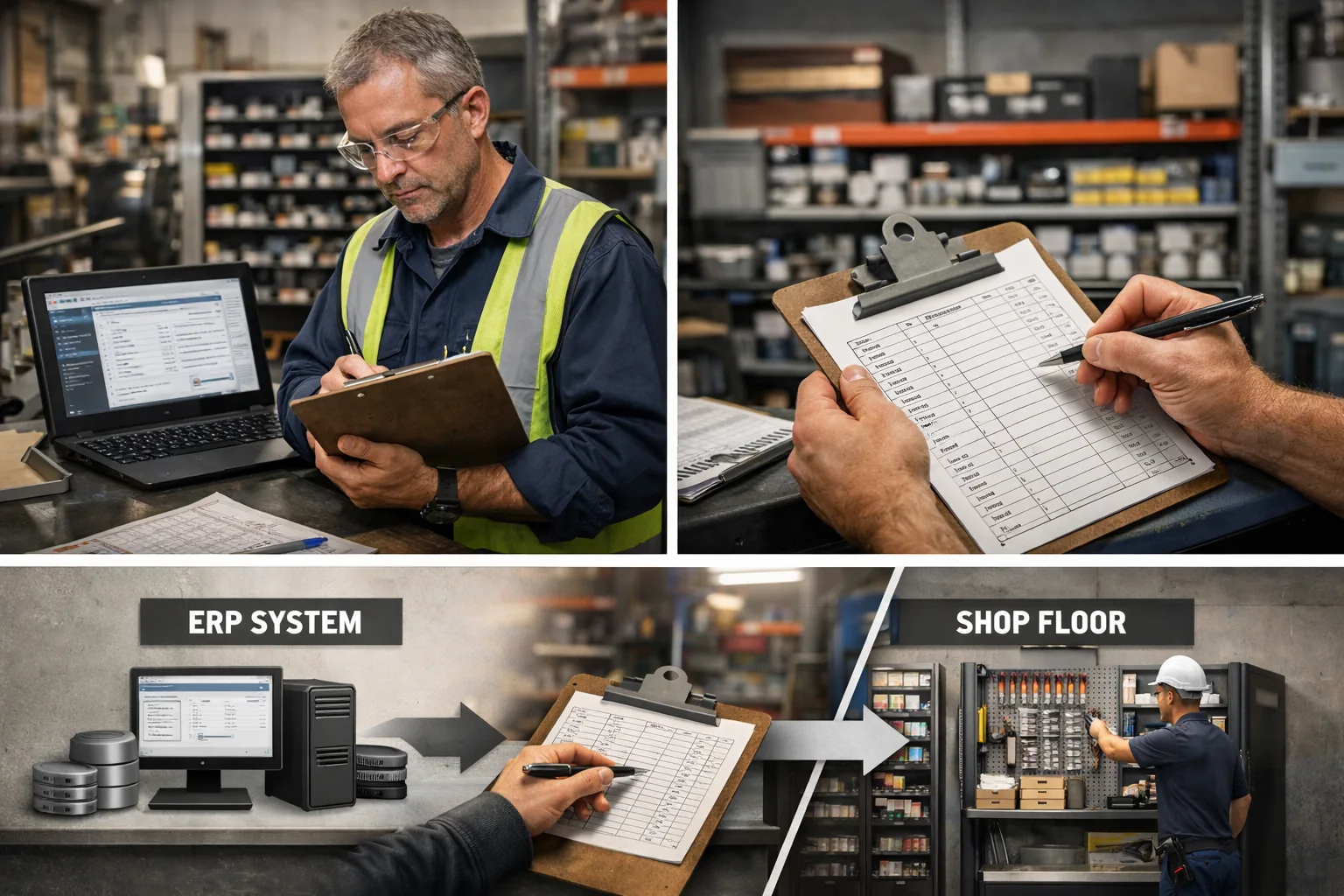
In many plants, inventory labor falls into four repetitive activities:
Physical counts and recounts
Cycle counts, spot checks, and end of month counts are often triggered because no one fully trusts the numbers.
Manual transaction entry
Parts are issued at the point of use, then logged later on paper, in spreadsheets, or retroactively inside the ERP.
Reconciliation and cleanup
Someone eventually compares physical stock, spreadsheets, and ERP quantities. This work doesn't improve production, it only attempts to prevent failures.
Exception handling
Emergency purchases, stockouts, misplaced items, and rush requests create interrupt-driven labor, which is the most expensive kind.
Why ERPs Don't Eliminate This Work
Systems like Prophet 21 are excellent at financial and transactional control. They are not designed to manage real time, point-of-use consumption on a plant floor. Consumption happens far from terminals. Transactions depend on memory and "I'll enter it later" becomes normal behavior. The ERP becomes a system of record, not a system of control, and labor is forced to fill the gap.
The Hidden Labor Capacity Cost
Consider a conservative hypothetical example:
- Two inventory staff spending 1.5 hours per day counting and reconciling
- Four supervisors spending 30 minutes per day resolving inventory issues
- Six technicians losing 10 minutes per day searching for parts
In this example, counting and reconciliation take 3 hours, issue resolution takes 2 hours, and searching for parts takes 1 hour, for a total of 6 labor hours per day. On an eight-hour workday, that is 0.75 full-time equivalent (FTE) of capacity spread across several roles. It does not imply a headcount reduction or cash savings.
Why "Just Be More Disciplined" Fails
Procedures, training, and audits can help, but they may leave the same manual steps in place. Capturing transactions where they happen can reduce reliance on memory and later data entry.
What Changes With Point-of-Use Automation
When inventory is captured at the point of use and the integration is configured for the workflow:
- Parts are issued as they're taken
- Configured transactions can flow into the ERP
- Usage records can help target physical counts
- Staff can review exceptions without re-entering every transaction
Industrial vending and automated dispensing can reduce manual steps between physical inventory and the ERP. Learn more about point of use inventory automation and how it connects to your existing systems.
Why This Matters Now
Labor is harder to hire. Supervisory time is more valuable. Plants are expected to scale without adding headcount.
Manual inventory tracking worked when volumes were lower and labor was cheaper. Those conditions no longer exist.
Inventory problems are rarely about accuracy alone. More often, they're about how much human effort is required just to keep systems aligned with reality. Reducing that effort is where real operational leverage comes from.